
A well-designed full-funnel approach helps brands stay present at every stage of the customer journey, from awareness to conversion and beyond. More importantly, it enables advertisers to build coherent and data-driven campaigns that maximize both reach and performance.
In this article, let’s explore:
- Why multi-touchpoint ecosystems outperform single-channel advertising
- Key media channels and their distinctive strengths across the funnel
- How brands can design, activate, and monitor a unified full-funnel campaign
Apart from diversifying channels, brands should know that scale is no longer the definitive characteristic of high-impact advertising strategy. Instead, they should focus on bettering the quality of traffic and impressions, so that attention – not mere visibility – becomes their goal.
What is a media strategy?
For brands, a media strategy is a comprehensive plan that indicates how they will present their images and messages across different channels and platforms to achieve key objectives. It is the blueprint for how brands will reach and engage with their target audience in a unified and well-coordinated manner.
Why is a media strategy important?
A well-planned media strategy connects brands with the right audience via the right channels, as well as maintaining a consistent and premium brand image. Ultimately, it helps them achieve business objectives and maximize ROI – which is especially important in today’s age, when using and allocating a budget smartly is critical.
Reaching the right audience
A well-crafted media strategy ensures that brands’ advertising efforts reach the right target audience, because it helps them:
- Identify correctly people that will be interested in the products or services
- Pinpoint what channels and platforms these audiences most likely engage with
Delivering a consistent brand experience
By outlining messages that a brand wishes to convey and how they are communicated, brands can ensure that their brand image is presented consistently across all touch points. As a result, they can strengthen brand recognition and trust with their audiences.
Adapting to changing consumer behavior
Consumer media consumption habits are constantly evolving, with new platforms and technologies regularly emerging. A media strategy allows brands to stay agile and adapt their approach to align with these changing behaviors and trends.
Measuring and optimizing campaigns with more data-driven insights
A media strategy provides a framework for setting measurable objectives and tracking key performance indicators (KPIs). This data-driven approach enables brands to continuously optimize media mix, messaging, and tactics for better results.
Maximize impact and return on investment (ROI)
For brands with a limited budget, it’s crucial to allocate resources effectively across various media channels. A media strategy helps brands spot and prioritize the most impactful channels, thus optimizing spending to achieve the best possible return on investment.

What makes a media strategy “full-funnel”?
A media strategy is considered “full-funnel” when it is intentionally designed to reach and influence consumers across every stage of the customer journey, rather than focusing on just one outcome like clicks or conversions.
A full-funnel strategy addresses all stages of the funnel as a connected journey:
- Awareness: Introducing the brand to new audiences
- Consideration: Educating users and building preference
- Conversion: Driving action, such as purchases or sign-ups
- Retention (optional but powerful): Encouraging repeat engagement and loyalty
A key differentiator of full-funnel media is audience flow. In a full-funnel strategy, messaging is sequenced and tailored, instead of being the same in all stages. Engagement data measured after each stage is utilized to enhance lower-funnel activities.
- Early-stage users see brand stories and value propositions
- Consideration-stage users receive product benefits and proof points
- High-intent users are shown offers, urgency, and strong CTAs

Why does a full-funnel media strategy matter?
A full-funnel media strategy helps brands meet the changing needs and expectations of modern consumers – who are increasingly digitalized.
Modern consumers rarely see an ad once and immediately convert. Instead, their journey happens across different channels.
Here is one example of the modern consumers’ journey. First, they may discover brands on social or video platforms. Afterwards, they do more in-depth research into the products via review sites, blogs, and social media. Then, they can be re-engaged through display, native, or retargeting ads, before finally converting after multiple exposures.
With such a complex map of touchpoints, single-channel campaigns often lead to missed opportunities to influence consideration and gradually guide users toward conversion.
Understanding the full-funnel: Corresponding channels and their advantages
A successful full-funnel strategy assigns each channel a clear role, based on how consumers behave at different stages of the journey.
Upper funnel: Awareness and reach
In this stage, the key goal is to maximize visibility and introduce the brand to new audiences. Even if users don’t click onto the ad or immediately convert, this initial exposure can likely influence their future behavior and, consequently, improve downstream performance.
Therefore, key channels employed are video, social media, and display ads. They stand out thanks to the ability to build connections fast and effectively.
- Video (Online Video, CTV): Videos can create impactful storytelling to build strong emotional engagement
- Social media ads: They have scalable reach with built-in interest-based targeting to foster fast awareness building
- Display ads and rich media: These ad formats enable impressive visual branding at scale on premium publishers. Therefore, they enable fast and scalable brand image building.

Mid funnel: Consideration and engagement
When a media strategy moves lower to mid funnel, the key objective is to educate users, build deeper trust, and encourage deeper interaction.
During this stage, brands tend to approach customers in a more close-knit and personalized manner. Therefore, they can benefit from channels such as native advertising, contextual display, and via search engines.
Doing well at the mid-funnel helps brands win customers when they are comparing options, so that they are more likely to be favored when decisions are made.
- Native advertising: This ad approach blends into content environments to strengthen brand presence among potential customers, thus potentially driving engagement.
- Contextual display: With contextual ads, brands can reach users right when they are actively browsing content relevant to their offerings
- Search engines (via non-branded and category keywords): Brands can leverage search engines to capture buyer intent as they are doing research and comparing their offerings to those of competitors.

Lower funnel: Conversion and action
At the funnel’s lower part, the goal of advertising is more aggressive: To drive measurable outcomes such as purchases, sign-ups, or converting to leads.
It is important to note that lower-funnel channels benefit directly from earlier touchpoints. It often converts more efficiently when users are already familiar with the brand.
Therefore, at this stage, brands should focus on the most high-impact channels that resonate with customers’ previously shown interests and encourage them to make a decision.
- Retargeting (via display ads and/or social media ads): This approach helps brands re-connect and re-engage users who have previously expressed interest.
- Performance search and shopping ads: These channels are where high-intent users are, so brands can touch on those that are ready to convert.
Dynamic ads: These ads deliver personalized creatives based on user behavior or product interest to strengthen their buying intent and, as a result, encourage decision-making.
How can brands create a full-funnel media strategy in 2026?
Building a full-funnel media strategy means making every touchpoint work towards the same branding outcome. Below is our suggested framework that brands can leverage to build a connected and coherent campaign that elevates their images.
Step 1: Start with unified goals instead of fragmented KPIs
While each channel will have its own specific targets, a connected full-funnel media strategy begins with one clear business objective. Therefore, brands should first define the primary outcomes they want to achieve, such as revenue growth, market entry, market share increase, or demand generation.
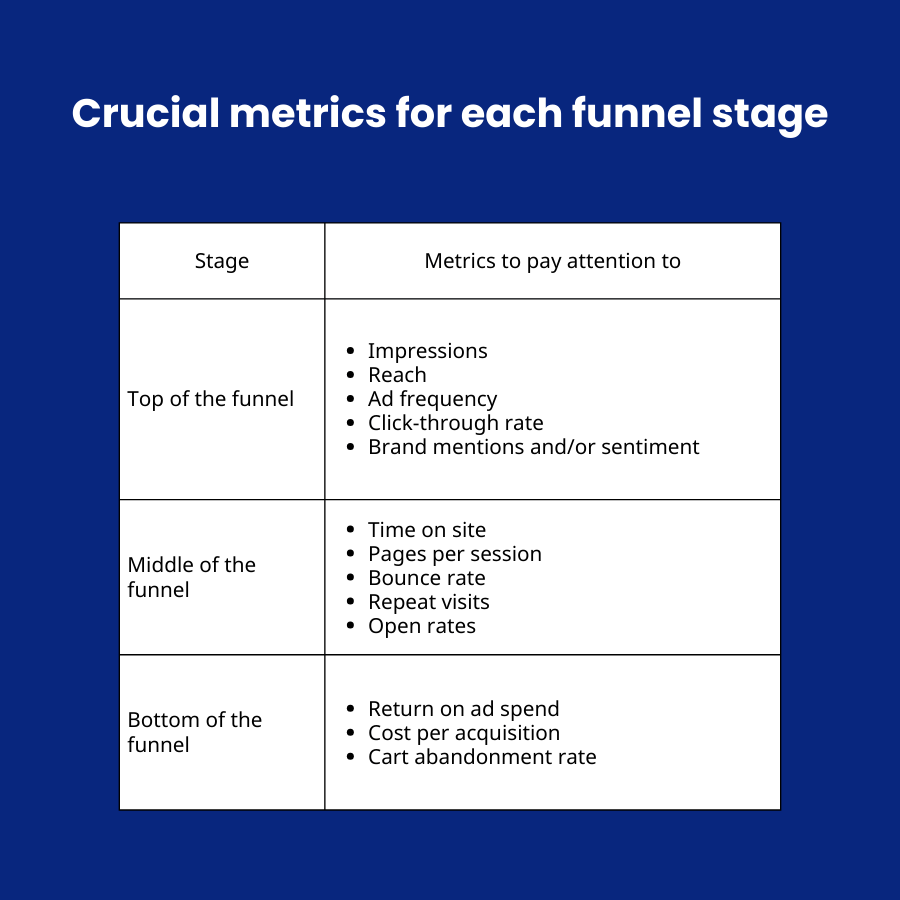
After these goals are defined, brands can start working on supporting KPIs for each stage. Brands can refer to Geniee’s sample table below as a starting point for designing their media strategy.
Step 2: Building consistent messaging across channels and touchpoints
A single, connected campaign does not mean running identical ads everywhere. Instead, messaging should evolve naturally as users move down the funnel.
At the upper funnel, the focus is on introducing the brand, such as its story, values, and core value proposition. In the mid funnel, messaging shifts toward product benefits, use cases, and differentiation, helping users evaluate why the brand fits their needs. At the lower funnel, creatives become more direct, emphasizing offers, urgency, and clear calls-to-action that drive conversion.
While the message adapts by stage, consistency in tone, visual identity, and brand narrative is critical. This consistency reinforces brand recognition and ensures that each touchpoint feels like part of the same journey, rather than a disconnected interaction.
Step 2: Building consistent messaging across channels and touchpoints
A single, connected campaign does not mean running identical ads everywhere. Instead, messaging should evolve naturally as users move down the funnel.
At the upper funnel, the focus is on introducing the brand, such as its story, values, and core value proposition. In the mid funnel, messaging shifts toward product benefits, use cases, and differentiation, helping users evaluate why the brand fits their needs. At the lower funnel, creatives become more direct, emphasizing offers, urgency, and clear calls-to-action that drive conversion.
While the message adapts by stage, consistency in tone, visual identity, and brand narrative is critical. This consistency reinforces brand recognition and ensures that each touchpoint feels like part of the same journey, rather than a disconnected interaction.
Step 3: Connecting different funnel stages via data
Data is what turns a multi-channel plan into a true full-funnel strategy. With data, brands can link stages and create a streamlined, measurable buying journey. For example, they can move users who have seen or engaged with awareness ads into consideration or retargeting segments.
Data also helps brands gain a holistic view of how their different channels are assisting performance as a whole – not just those that encourage the final click on the “Buy” button.
Step 4: Monitoring and optimizing
With its complex nature, a full-funnel media strategy requires continuous management and optimization based on real-time insights and fluctuations.
Brands should regularly review performance across all funnel stages and adjust budgets accordingly. If awareness or consideration metrics weaken, lower-funnel performance will often follow. Similarly, identifying channels that consistently assist conversions allows brands to invest more strategically, even if those channels are not the last point of interaction.
Creative optimization also plays a key role. By analyzing engagement rates, drop-off points, and audience responses, brands can refine messaging to better support each stage of the funnel.
Final thoughts
A single, connected full-funnel campaign is built on aligned goals, evolving messaging, connected data, and ongoing optimization. When executed correctly, it turns multiple channels into one unified growth engine that helps brands make sure the chance of conversion is optimized from the very first touchpoint.
FAQs about full-funnel media strategy
What is a full-funnel media strategy?
A full-funnel media strategy is an approach that engages consumers across every stage of the customer journey (from awareness and consideration to conversion) using connected channels, messaging, and measurement.
How is a full-funnel campaign different from a performance-only campaign?
Performance-only campaigns focus on immediate conversions, while full-funnel campaigns build demand earlier in the journey, making lower-funnel media more effective and scalable over time.
Do brands need to use every channel to run a full-funnel strategy?
No. A full-funnel strategy is defined by alignment and connection, not the number of channels. The key is assigning each selected channel a clear role within the funnel.
How long does it take to see results from a full-funnel approach?
Upper- and mid-funnel impact may take time to materialize, but brands often see improved conversion efficiency and stronger ROAS in later stages, thanks to the maturity of awareness and consideration.
How should success be measured in a full-funnel campaign?
Success should be measured holistically, using a mix of brand metrics, engagement data, assisted conversions, and performance outcomes, rather than relying solely on last-click attribution.
Is full-funnel media only for large brands with big budgets?
No. Full-funnel strategies can be scaled to fit different budgets. Even smaller campaigns benefit from aligning messaging and connecting touchpoints across the funnel.
0 Comments